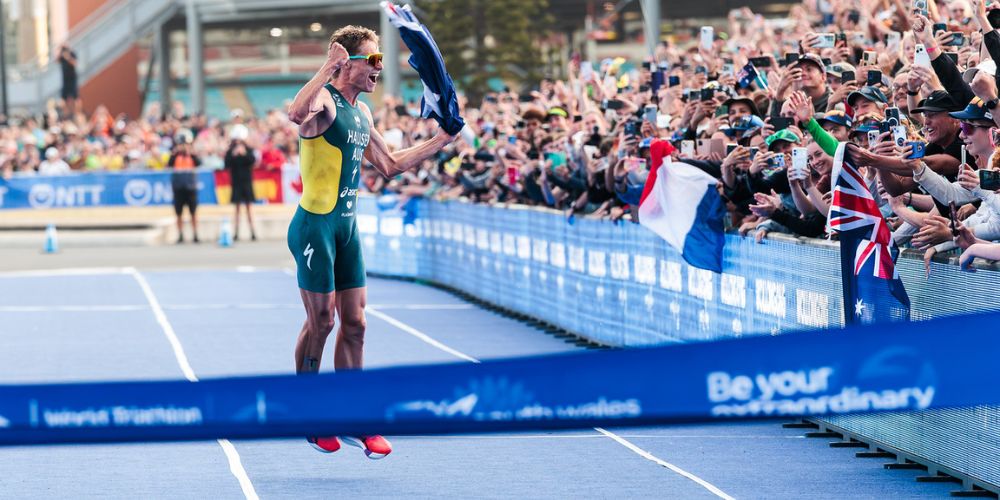
Becoming world champion didn’t suddenly make Matt Hauser untouchable, it simply raised the stakes.
After climbing the summit of world triathlon last year in Wollongong, Hauser still has a lot to achieve.
Ending a 20-year drought for Australian triathlon was just the beginning, now he’s ready to prove that it was no fluke.
“Apparently according to a few close mates, I’ve changed,” he laughs. “But I don’t believe that at all.”
The joke lands easily, but beneath it sits the reality of what comes after reaching the summit of a sport built on suffering.
“There will be people coming after me from here on in towards LA 2028,” he says. “I just need to embrace that challenge and keep fighting the good fight.”
Fighting the good fight says everything about Hauser’s approach to triathlon.
His success has never been built on swagger or shortcuts. It has been built on grit. On the willingness to repeatedly push himself into places most athletes spend their careers avoiding.
The dark places.
“There is certainly such thing as mental scarring and physical scarring,” he says. “When you go to deep dark places to try and find the best out of yourself, it takes twice as much to get back there.”
That is the reality of elite sport few people see.
The world sees the winning tape in Wollongong. Hauser remembers the anxiety before sleep. The race simulations running through his head weeks before the start line. The pressure of carrying expectations on home soil as the world number one.
“The biggest challenge was handling the pressure of going into the world championship as number one and delivering on home soil,” he says. “It was probably the most stressful but the most enjoyable period of my sporting career.”
It also confirmed something to himself.
That when the pressure arrived, he could stand in it.
At 28, Hauser is no longer the talented junior rubbing shoulders with Australian greats at his first world championships in Chicago back in 2015. He is now the athlete younger Australians look toward. The standard bearer. The one expected to deliver.
But he refuses to let success soften him.
“I don’t want to be a one-hit wonder,” he says. “Legacy is being consistently great.”
That obsession with consistency has transformed every part of his career.
Looking back four or five years ago, Hauser believes he was only scratching the surface of what being an elite athlete actually required.
“I feel like I was a bit of a part-time athlete back then,” he admits. “I was committed to the cause, but I just wasn’t doing the one, two, three percenters.”
Now, everything matters. Sleep. Nutrition. Recovery. Travel. Focus. The tiny details that separate finalists from champions.
“I’m just addicted to getting better,” he says. “I’m really passionate about improving myself every day.”
It sounds simple. But triathlon has a brutal way of testing whether athletes truly believe, when things become uncomfortable.
Hauser’s greatest strength may not be physical at all. It is his ability to remain composed when pain and doubt arrive together.
“When you’re pushing high power, your heart rate’s high, you’re in a pressure situation, your body’s telling you to stop this immediately,” he says. “You just have to snap yourself out of that and focus on the job at hand.”
That mindset, the ability to compete while suffering, has become central to who he is.
Long before world titles and Olympic ambitions, it was already there in smaller ways.
Board games with family. Scrabble battles with his grandmother. Competing against his fiancée in almost anything.
“I’ve been a very competitive person naturally from a young age,” he says.
Now, that competitiveness is sharpened by purpose.
The Olympic Games remain the biggest driver.
Hauser has already experienced two Olympics, the eye-opener of Tokyo and the momentum shift of Paris, but Los Angeles in 2028 feels different.
“For me now to be in a position where I can potentially challenge for a medal is super motivating,” he says.
He knows what the Olympics demand now. Not just physically, but emotionally. The noise. The expectation. The endless pull of media, friends and family wanting to be part of the experience.
“People say it’s just another race,” he says. “But I think the importance is realising it’s not just another race. It is a really special moment.”
That perspective, embracing pressure instead of fearing it, has become one of the defining characteristics of Hauser’s career.
But even world champions do not survive alone.
If Hauser represents the face of Australian triathlon’s rise, then coach Dan Atkins is one of the architects behind it.
Their relationship has lasted more than a decade, shaped by shared ambition, emotion, sacrifice and countless hours spent travelling the world together.
“I probably spend more time with him than I have with my family over the past 10 years,” Hauser says.
Atkins, according to Hauser, is also an ‘airport dad’, the kind of person arriving at gates 45 minutes early and stressing over passports while athletes try to stay calm around race day.
But beneath the humour sits enormous respect.
“He’s the one in the background making sure the cogs are working smoothly,” Hauser says. “A lot of credit goes towards him.”
The same applies to the training environment around him. Athletes like Brandon Copeland and Brayden Mercer are more than training partners. They are part of the ecosystem pushing Australian triathlon forward again.
Hauser can feel the momentum building.
After years in the wilderness, Australian triathlon is climbing again, world titles, relay success, emerging talent and crowds reconnecting with the sport.
Nothing captured that shift more than Wollongong.
“The atmosphere was overwhelming,” he says. “Probably the best atmosphere we’ve had for an Australian triathlon event ever.”
For Hauser, the victory mattered because it belonged to more than him. It belonged to the people lining the barriers. The teammates pushing through sessions beside him. The coaches, staff and younger athletes now believing Australia can again lead the world.
“I want to compete and race well for my country, not just for myself,” he says.
Despite all the intensity, there is another side to Hauser away from racing.
He talks about vinyl records and coffee with the same relaxed enthusiasm he brings to competition. He loves AFL. He follows both the Brisbane Lions and the Gold Coast Suns. He spends time around the Suns learning from another high-performance environment.
Most of all, he talks about his fiancée, and their dog Maple, a Vizsla who may or may not end up carrying the wedding rings.
“She might get hold of the wedding cake and that’ll be the end,” he jokes.
Those moments matter because they keep the sport in perspective.
Hauser credits his fiancee as perhaps the single biggest influence on his career.
“She enables me to enjoy things outside of the sport no matter how things are going on the course,” he says.
That balance has become increasingly important as the demands of elite competition continue to grow.
Because underneath the world titles, the expectations and the Olympic dreams, Hauser understands something essential about longevity.
Grit is not just about surviving pain.
It is about continuing to choose the work every day after success arrives.
That is why becoming world champion has not satisfied him. If anything, it has sharpened the hunger further.
Success over the next 12 months could mean another world title. It could mean consistency. It could simply mean continuing to improve.
Because the real target still lays waiting.
“The greater cause,” he says, “is success at the LA Olympic Games in 2028.”
And maybe beyond that, there is even the possibility of one final chapter at the 2032 Summer Olympics.
Hauser laughs at the idea of still competing at 34.
“I might be a broken man by then,” he says.
But then he pauses.
“To compete for Australia at a home Olympic Games… that would certainly be a sweet way to go out.”