For most elite triathletes, the journey starts in the pool.
For Anu Francis, it started with admitting she couldn’t swim 25 metres.
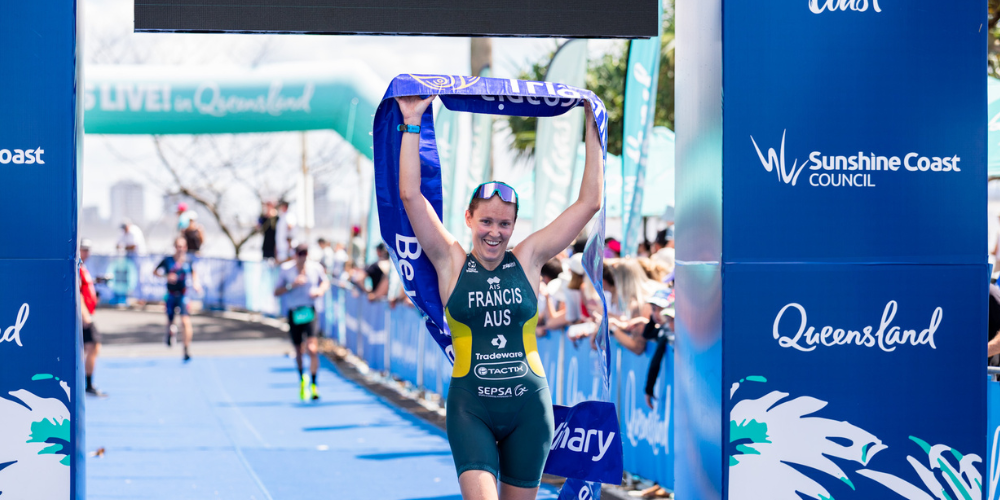
Now, just five-and-a-half years later, she is a World Champion, Paralympian, one of Australia’s brightest para triathlon stars, and living proof that reinvention can become a superpower.
Francis’ rise through the sport has been anything but conventional.
Before triathlon, she had already lived several different lives as an athlete. There was para badminton, where she first found community after being diagnosed with disabilities later in life.
Then para rowing, where she began to believe the Paralympics could genuinely become reality.
Triathlon wasn’t the obvious choice.
“I thought cycling would probably suit me more because I couldn’t really swim and I’d only just started riding a bike,” Francis recalled.
But when the opportunity came to try para triathlon in 2020, something clicked.
“It just seemed new and exciting,” she said.
That excitement quickly collided with reality.
Francis remembers her first pool session vividly. Her coach, who had already been working with her as a gym coach, simply asked her to swim one lap.
“I told him, ‘No, I’m serious. I can’t swim.’”
What followed was years of relentless work. Four and five swim sessions a week. Tiny improvements. Slow progress. Learning a skill most elite athletes develop as children, but doing it as an adult with the pressure of Paralympic ambitions looming.
“Learning to swim as an adult is very hard and very daunting,” she said.
Yet Francis kept showing up.
Not because motivation magically appeared every morning, but because she had a vision she refused to let go.
“There were mornings at 4am where I’d literally look at the Paralympic rings and think, ‘That’s where I want to be.’”
It is that honesty that makes Francis’ story resonate far beyond sport.
She does not romanticise elite performance.
She talks openly about exhaustion, setbacks, rejection and doubt. About waking up tired. About doors closing unexpectedly.
Before becoming a world-class triathlete, Francis had been studying veterinary medicine, her dream career since childhood. But after receiving her diagnosis, she says she was told registration pathways would likely prevent her from practising.
Later, while studying education and special education, she encountered similar barriers again.
For many people, that kind of rejection would become the endpoint.
For Francis, it became motivation, a new beginning.
“I’ve never really seen giving up as an option,” she said.
Instead, she pivoted. Again and again.
Today, alongside elite racing, Francis studies clinical exercise physiology, works in disability support, coaches triathlon and advocates for greater inclusion and accessibility for people with disabilities.
That broader purpose sits at the heart of everything she does.
While medals and results matter, Francis believes the real power of para sport lies in visibility.
“When I was growing up, I didn’t really have role models with disabilities,” she explained. “You have to see it to be it.”
Now, she has become exactly that for the next generation.
Not just for future Paralympians, but for young people with disabilities trying to imagine what their lives might look like beyond the barriers society places in front of them.
“If someone wants to be a doctor, a teacher or a vet, that should be possible too,” she said.
“People with disabilities are completely capable. We just need the right support.”
That perspective has helped shape Francis into one of the most respected figures within Australian para triathlon circles.
Teammates speak about her energy, resilience and leadership. Coaches speak about her work ethic. Francis herself speaks most passionately about community.
She credits Adelaide-based Flow Endurance for helping her feel included from the moment she entered the sport. Training alongside athletes of all ages and abilities gave her not only confidence, but belonging.
“It never felt like I was doing it alone,” she said.
Triathlon also unexpectedly reconnected her with family overseas.
International racing allowed Francis to rebuild relationships with relatives in England she had not seen since childhood, turning European race campaigns into emotional reunions and creating a second support network on the other side of the world.
Then came the breakthrough.
After the disappointment of the Paris Paralympics and illness derailing her 2024 World Championship campaign, Francis entered the 2025 World Championships in Wollongong carrying both confidence and unfinished business.
For years, she had viewed herself as the underdog in a field dominated by American athletes.
In Wollongong, that mindset changed.
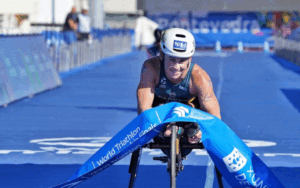
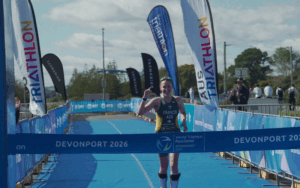
Racing on home soil against a full-strength international field, Francis produced the performance of her career to claim the World Championship title in front of family, friends and teammates.
“It was the most satisfying win,” she said. “I felt like I earned every part of it.”
The victory validated years of sacrifice, setbacks and persistence. But perhaps more importantly, it changed how Francis saw herself.
“For the first time, I felt like I really belonged there.”
Now ranked World No.1 heading toward LA 2028, Francis is no longer chasing belief. She carries expectations instead.
And she welcomes it.
“Pressure is a privilege,” she said.
Los Angeles already sits heavily in her thinking, not simply as another Paralympics, but as redemption.
Francis arrived in Paris having almost never missed a podium in her para triathlon career outside of races impacted by crashes and concussion recovery. Internally, she expected to medal.
Instead, she finished fourth.
“I was in a big state of shock afterwards,” she admitted. “I felt like I had a good race, but I just missed out.”
Looking back now, Francis believes the experience of her first Paralympic Games taught her lessons impossible to learn any other way.
“People say it’s just another race, but it’s not,” she said. “There’s so much noise around it, the media, the village, everything happening around you. You can’t really understand it until you experience it.”
That perspective has shifted how she is approaching LA.
This time, she wants to arrive calmer. More prepared. More confident in herself and her environment. Not overwhelmed by the scale of the event, but empowered by it.
And unlike Paris, where expectation felt uncertain and new, Francis is completely clear on what she wants in Los Angeles.
“My eyes are fully set on gold,” she said.
For now, however, the focus is on development rather than results. Francis sees the next 12 months as a crucial building phase, refining swim technique, trialling bike modifications and improving her AFO leg braces as she builds toward the qualification period.
Rather than obsessing over wins every weekend, she has become more process-driven.
“One race might be about focusing on the swim. Another might be about testing equipment or hitting certain KPIs,” she explained. “The goal is that by the time LA comes around, everything else is sorted and all I have to think about is racing.”
Despite the growing attention surrounding her career, Francis remains remarkably grounded about the spotlight. Ahead of Paris, the flood of media requests initially became overwhelming, forcing her to learn how to manage expectations and protect her own energy.
She genuinely enjoys telling her story.
“Para triathlon doesn’t always get a lot of coverage,” she said. “So if we can get more eyes on the sport, that’s always a positive.”
That openness perhaps explains why Francis is such a compelling figure beyond race results. She is equally comfortable discussing elite performance as she is disability advocacy, accessibility, climate activism or animal rights.
In another life, she laughs, she might have ended up somewhere completely different altogether.
Long before the Paralympics became the dream, Francis wanted to join the circus.
Not metaphorically. Literally.
As a teenager, she sang competitively through school, learned circus skills and dreamed of one day performing with Cirque du Soleil. She can still ride a unicycle, walk on stilts and juggle, talents she jokes may resurface if triathlon ever ends.
“Being a vet was my practical career,” she laughed. “Being a circus performer was ‘the’ dream.”
The detail feels strangely fitting for someone whose life has never followed a straight line.
Athlete. Advocate. Performer. Student. Coach. World Champion.
Francis herself sums the journey up in three words:
“Exciting, tumultuous and groundbreaking.”
And perhaps that is exactly why her story resonates so deeply.
Because every closed door in Anu Francis’ life has somehow become the beginning of something even bigger.