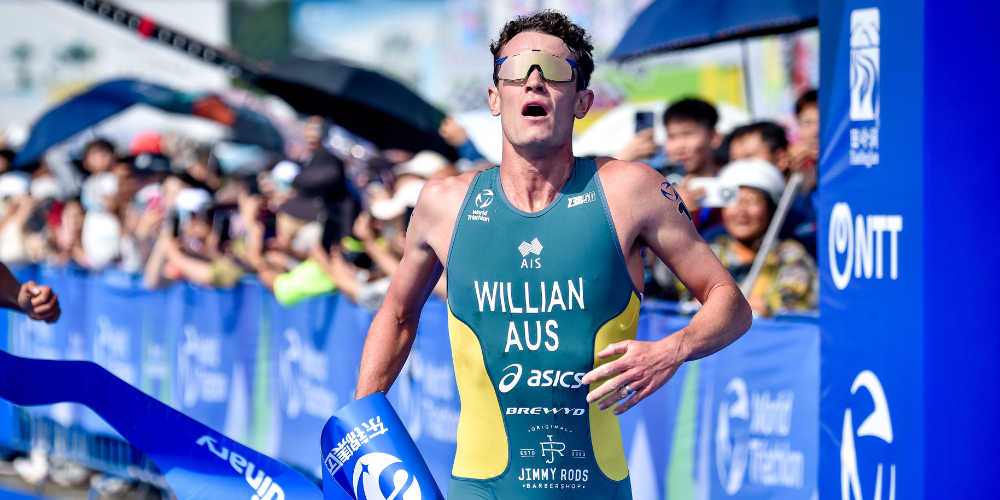
When Luke Willian talks about the biggest lesson of his career, it isn’t about swimming, cycling or running.
It’s about letting go.
The Brisbane triathlete is enjoying one of the strongest periods of his career, opening the 2026 season with victory in China and a podium finish in Yokohama. He now races with a confidence that wasn’t always there, the belief that he belongs among the world’s best and can challenge for victories whenever he stands on a start line.
But that confidence was forged through one of the most difficult chapters of his sporting life.
“I spent a long time carrying disappointment,” Willian says.
For years, the dream of representing Australia at the Olympics consumed him. Ranked inside the world’s top athletes and sitting second among Australians during the qualification period, Willian felt he had done enough to earn selection for the Tokyo Olympics.
Instead, he missed out.
The disappointment lingered far longer than he expected.
“It probably took me two and a half years to really get over it,” he admits.
“I was so angry. I kept trying to race with that anger and I was trying so hard all the time. Nothing was really working because I hadn’t let go of the weight I was carrying.”
The frustration threatened to derail everything.
By early 2024, after a poor performance in Napier, Willian found himself questioning whether his professional career had reached its end.
“I was getting pretty close to thinking maybe I’d need to go and get an office job and use the degree I’d spent seven years completing.”
Instead, he made a decision that would change everything.
Rather than chasing Olympic qualification, he focused on something simpler: making himself proud.
“Just leave no stone unturned,” he recalls telling himself.
“If I did everything I possibly could, then I had to be okay with whatever happened.”
That shift in mindset sparked one of the most memorable runs of his career.
A breakthrough performance at Devonport reignited his belief before a fourth-place finish in Hong Kong secured automatic selection for Yokohama. Then came the race that ultimately booked his ticket to Paris.
A crash on the final lap of the bike leg threatened to destroy his Olympic dream.
Most athletes would have accepted their fate.
Willian jumped off his bike, hurdled fallen riders, remounted and chased desperately to reconnect with the lead group.
“It took me nearly the whole lap to get back on.”
Then came the run.
“I just ran as hard as I could.”
When he crossed the line and realised he’d done enough to qualify, the moment was about far more than an Olympic berth.
“It was a full-circle moment,” he says.
“I’d left no stone unturned.”
Ironically, it wasn’t a World Championship podium or World Cup victory that Willian considers one of the defining performances of his career.
That honour belongs to a second-place finish at the Devonport Oceania Sprint Championships.
On paper, it’s a modest result compared to his growing international résumé.
For Willian, it meant everything.
“That was the race where I finally let go of the past.”
“I ran faster than I’d ever run before. It wasn’t the biggest result I’ve had, but it marked the start of a new chapter.”
Today, that chapter is producing some of the best performances of his career.
The athlete who once aimed for top-10 finishes now arrives at races with a different mindset.
“I can win these races.”
“That’s the goal every time I show up now.”
That confidence is reflected in his personal mantra for 2026.
“Until the wheels fall off.”
It’s a phrase that perfectly captures Willian’s racing style.
No holding back. No racing for safe results.
“If you fail trying to win, that’s okay.”
“It’s worse than succeeding when you’re not trying to win.”
Away from competition, Willian remains grounded by the simple things that first attracted him to triathlon.
Growing up in Brisbane, he initially joined a junior triathlon program after his parents encouraged him and his brother to find a summer sport. He quickly discovered he loved the combination of individual responsibility and team camaraderie.
Today, nearly two decades later, he still finds joy in the everyday moments.
A sunrise ride up Mount Nebo.
A run across the Story Bridge.
Swimming around reefs and islands while travelling the world.
“It’s pretty cool that I get to call Brisbane home and this gets to be my job.”
His journey has also been shaped by one of the longest athlete-coach relationships in Australian sport.
Willian has worked with the same coach since he was 11 years old.
The partnership has survived junior development, Olympic heartbreak, international success and nearly two decades of highs and lows.
“It becomes more of a partnership than a coach-athlete relationship.”
“He knows me better than I know myself sometimes.”
That support network extends to the close-knit group of Australian men’s triathletes who have pushed each other for more than a decade.
World champion Matthew Hauser, Braden Mercer, Callum McClusky and others have risen together through the junior ranks and into the elite level.
“It can be a lonely sport.”
“Having those guys there for the journey makes it a bit less lonely.”
The strength of Australian triathlon is something Willian believes is helping drive the next generation to even greater heights.
“When everyone’s fighting for the top spot, it makes everyone better.”
For now, however, Willian’s focus remains firmly on the present.
The long-term target of Los Angeles 2028 sits in the background, underpinning every decision and training session.
But unlike previous Olympic campaigns, he isn’t allowing the Games to dominate his thinking.
“LA will come if I get the results I want.”
“In the past I was probably chasing the Olympics too much. Now I’m chasing personal success.”
That approach appears to be working.
After years of setbacks, lessons and hard-earned perspective, Luke Willian is finally racing free.
And when he talks about the future, there is no hint of the frustration that once defined him.
Just belief.
The belief that the best performances of his career may still be ahead of him.