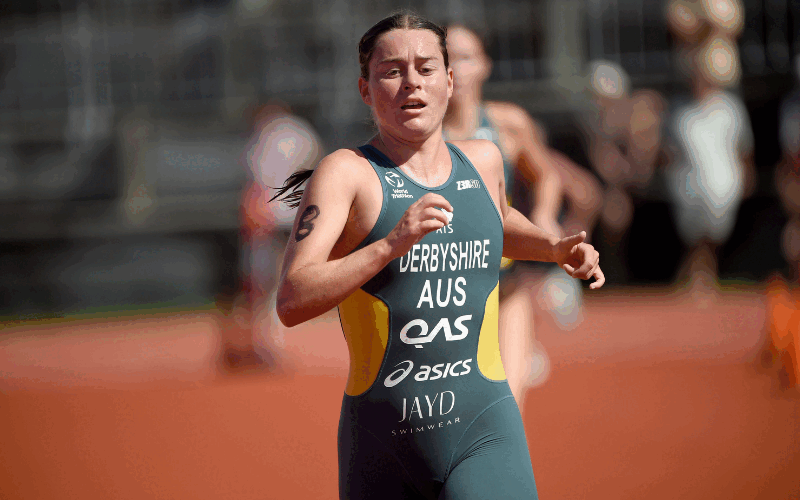
For a long time, Charlotte Derbyshire thought success in triathlon meant winning everything.
As a junior growing up in Adelaide, that mindset made sense. She was talented early. Strong across multiple sports. Competitive by nature. The results came quickly too, state championships, national podiums, Australian team selections.
But eventually, the pressure that once drove her started becoming heavier than the joy of the sport itself.
“I won quite a lot as a junior,” Derbyshire says. “I found it really hard stepping up into Under-23s trying to keep that.”
No coach created that pressure. No family expectation pushed it onto her.
“It was a lot of pressure I put on myself,” she says.
That internal battle would eventually force Derbyshire to confront a difficult question many athletes spend years avoiding.
Was she still doing triathlon because she loved it?
Or because she felt she had to?
Today, watching Derbyshire race, it is difficult to imagine there was ever uncertainty. She looks composed, grounded and quietly confident, an athlete who understands herself far better now than she did as a teenager chasing junior success.
But getting there required change.
A lot of it.
Her journey into triathlon started almost accidentally. Derbyshire already had strong foundations through athletics and surf lifesaving when a teacher at school suggested she add cycling into the mix.
“He said I’d be really good at triathlon if I just added the bike leg,” she remembers.
She entered a few races, won the South Australian state championships, then placed third at nationals in her first year competing at that level.
“That was probably when I thought, ‘I think triathlon is the direction I want to go in.’”
At the time, she was still just a kid from Adelaide figuring things out.
But by the end of school, the pathway ahead became clear.
If she wanted to chase triathlon seriously, she needed to move.
In 2018, Derbyshire relocated to Queensland, the heartland of Australian triathlon, expecting a fresh start. What she did not expect was that her entire family would move too.
“My whole family actually ended up moving up with me,” she says.
Her parents and sisters packed up everything to support not only Charlotte’s ambitions, but also the sporting dreams developing across the family. Her younger sister Lucy was deeply involved in surf lifesaving and competing in the Ironman series herself.
The Derbyshires are, by Charlotte’s own admission, “competitive”.
But underneath the competitiveness sits something far more important: support.
“They just want me to be happy,” she says of her parents.
That perspective became crucial during one of the hardest periods of her career.
In 2023 and 2024, Derbyshire’s relationship with triathlon began to fracture. Results were inconsistent. Confidence faded. Most painfully, she missed selection for the Under-23 World Championships in what was her final eligible year.
“I definitely kind of thought about if this is what I wanted to do,” she says.
For athletes who have spent years attaching identity to performance, moments like that can become breaking points. Derbyshire had built expectations around herself for so long that when things stopped going perfectly, the joy disappeared with it.
Then came a reset.
A change in training environment. A new squad. A new coach. Most importantly, a return to enjoying the process again.
“That began my love back for the sport,” she says.
Now based on the Gold Coast, Derbyshire trains under coach Mick Ferris in Cabarita Beach, alongside a squad environment she describes as both high-performing and fun.
The relationship works because it feels collaborative.
“As an older athlete, you definitely know what works for you,” she says. “I like that we both have input.”
That sense of ownership over her career has changed everything.
Instead of obsessing over outcomes, Derbyshire now talks more about process. About small victories. About incremental progress.
A PB in the gym. A technical breakthrough in the pool. A training session finally clicking after weeks of frustration.
“Success can be little wins throughout the week,” she says.
That shift in perspective has helped her rediscover consistency, and eventually, belief.
Last year, Derbyshire earned her first World Cup podium, a result that carried more emotional weight than many people realised.
“After years of finding it hard to be in the sport and not having results I was super proud of, that one really was a proud moment,” she says.
It felt like validation.
Not just that she belonged at that level, but that staying patient through the difficult years had been worth it.
“It made me feel like all my training was worth it.”
There is a maturity now in the way Derbyshire approaches racing that only comes from navigating adversity.
When races start falling apart, she no longer panics.
“You just need to stay grounded and concentrate on yourself,” she says. “You can’t worry about what’s happening around you.”
That composure has helped shape her into one of Australia’s most balanced triathletes. While she once identified the run as her clear strength, Derbyshire now believes she is solid across all three disciplines.
“I don’t actually think I have a strongest leg anymore,” she says.
That versatility matters at the highest level of international racing, particularly as she builds toward bigger goals.
The Olympics sit firmly in the background of everything now.
After representing Australia at the 2018 Summer Youth Olympics and racing at the World Championships on the Gold Coast in 2018, Derbyshire understands the pride that comes with wearing the green and gold.
“There’s nothing better than having a home crowd,” she says. “You’ve got your family and friends supporting you and all the Aussie accents cheering.”
Now, the focus is on something bigger.
2028 Summer Olympics.
“Getting to LA would just be a dream come true,” she says. “It’s the ultimate goal.”
And perhaps beyond that, there is the possibility of 2032 Summer Olympics too, though Derbyshire laughs and admits she will “see how she feels” after Los Angeles first.
What makes Derbyshire compelling is not just her results, but the way she speaks about longevity and perspective in a sport that can consume young athletes quickly.
If she could give one message to younger athletes entering triathlon, it would not be about winning.
In fact, it is almost the opposite.
“When you’re younger, you think you have to win everything in that moment,” she says. “But it’s such a long journey.”
She wants young athletes to enjoy the sport before they turn it into pressure. To focus on friendships, experiences and growth before obsessing over outcomes.
That advice feels deeply personal because she learned it herself the hard way.
These days, away from training, Derbyshire’s life feels intentionally balanced. She studies teaching, works at Somerset College and coaches younger triathletes. She spends downtime at the beach, with friends, or grabbing coffee around the Gold Coast.
Working with kids has become especially important to her.
“I really love helping them out,” she says.
That nurturing side of her personality shapes how she hopes people remember her one day.
Not necessarily as the athlete with the biggest results.
“I just want to be remembered as someone who was good fun to be around,” she says. “A good person. Someone who helps younger people coming up.”
For an athlete who once placed enormous pressure on herself to constantly win, that answer says a lot about how far she has come.
Charlotte Derbyshire still wants success. She still dreams about Olympic Games, podiums and world-class performances.
But now, she understands something younger athletes often miss.
The best careers are not built by forcing perfection every day.
They are built by learning how to love the process enough to stay.