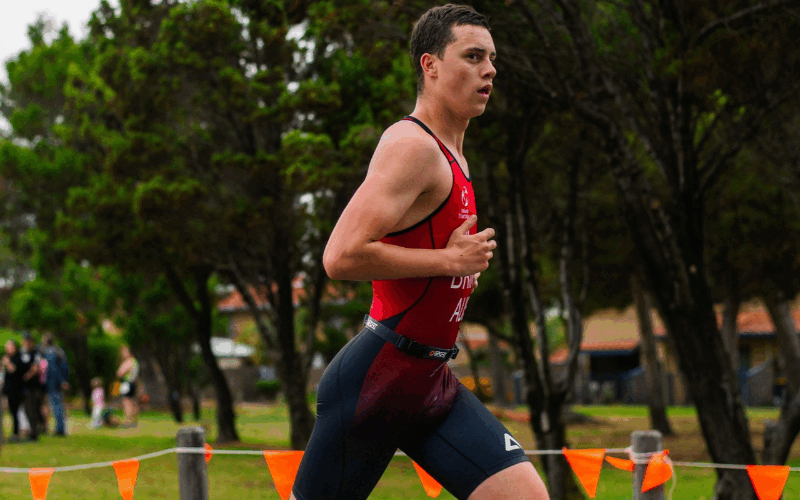
For Connor, triathlon wasn’t always the plan.
Growing up as a swimmer, he first ventured into the sport after being inspired by local races and encouraged to give it a try. What started as curiosity quickly became a passion. After completing his first triathlon, Connor discovered a competitive drive that would fuel his commitment to the sport.
“I wanted to start winning these things,” he said. “There was a fire there to grow and become the best I could.”
Like many athletes transitioning from a single-discipline background, Connor found the swim leg came naturally. The challenge was building strength and confidence on the bike and run. In the early days, most of his focus remained in the pool, with cycling and running fitted around school and swimming commitments.
Over time, consistency became the key.
Working alongside coach Ross, Connor developed a more structured approach to training, balancing his workload across all three disciplines and steadily improving as a complete triathlete.
That progress was put to the ultimate test ahead of his first World Championships appearance in Townsville.
Just as Connor was preparing for his international debut, he experienced what initially felt like an asthma attack during training. The symptoms wouldn’t subside, and further medical examinations revealed something far more serious: a spontaneous tear had caused his lung to collapse.
The diagnosis led to surgery and more than a week in hospital, followed by several weeks away from training.
“It was a long process to get back into it,” Connor recalled.
For many athletes, such a setback could derail momentum. For Connor, it became another challenge to overcome.
The following year, Connor arrived at the World Championships in Wollongong fitter, healthier and determined to make the most of the opportunity.
What happened next exceeded even his own expectations.
Despite never having stood on a national podium and having previously achieved results around the top 15 level, Connor produced the race of his life to claim the World Championship title.
The magnitude of the achievement didn’t sink in immediately.
“It’s one of those surreal feelings,” he said. “It doesn’t really hit you until afterwards.”
In fact, one of his first calls after crossing the finish line was to his mother.
“I rang Mum and said, ‘Mum, I won.’ She was shocked. I was shocked too.”
The victory was about far more than a medal. It represented years of training, sacrifices, setbacks and unwavering support from family, coaches and friends.
“It was satisfying to know that all the hard work, time and sacrifices were worth it in the end.”
Now, he’s preparing to take on the world’s best once again at the World Triathlon Championship Finals in Pontevedra, Spain.
Rather than becoming consumed by expectations after winning in Wollongong, he has focused on the process that got him there.
“I try not to overthink things too much,” he said. “I focus on the small goals, the schedule for the week, and what I need to do each day.”
It will also be Connor’s first opportunity to race many of the top European athletes on their home turf, an experience he is eagerly anticipating.
“I’ve had a lot more consistency this year, and I’m really looking forward to racing against the Europeans for the first time.”
Away from triathlon, Connor is also studying podiatry at university.
Juggling elite-level training, exams, family commitments and friendships often feels like “living chaos”, but it is a balancing act he has learned to embrace.
Like many student-athletes, success relies on careful planning, flexibility and a strong support network.
“I’ve got to thank my parents, my coach and my university. Even if I just need someone to talk to when I’m stressed, they’ve always been there.”
Connor credits much of his development to the support of his local triathlon community, representing Tempo Systems Triathlon Club in South Australia.
The club’s welcoming culture helped foster his love for the sport, and now he enjoys helping younger athletes who are beginning their own journeys.
Having entered triathlon later than many of his peers, he understands the value of mentorship and guidance.
“I like being able to help guide the younger athletes through the sport. That’s something I didn’t always have when I started.”
As he prepares to pull on the Australian uniform once again, Connor hasn’t lost sight of what the opportunity means.
Representing Australia remains one of the proudest moments of his sporting career.
“It’s one of those surreal feelings,” he said. “There’s nothing else you can really compare it to.”
Competing overseas in the green and gold for the first time will make the experience even more special.