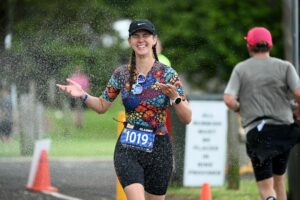
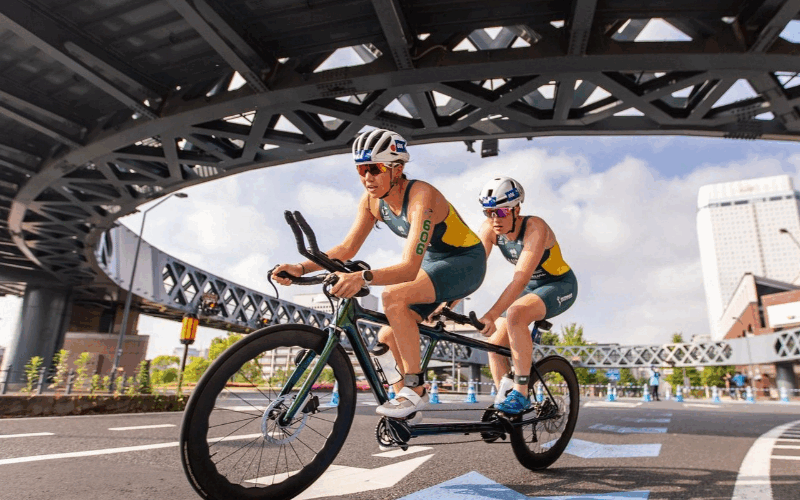
For Australian para-triathlete Maggie Sandles, the road to elite sport did not begin with grand ambitions of Paralympic glory.
It started in the uncertainty of COVID lockdowns, when a teenage rower was sent home from school and simply needed a way to stay active.
“Triathlon was kind of a natural progression through COVID,” Sandles said.
“I started out as a rower through high school and then got sent home in year 12 to the country where my mum lives. It was three sports that I could do by myself and it kind of went from there.”
What followed was a chain of events that would completely reshape her life.
Sandles’ mother encouraged her to reach out to Rio Paralympic gold medallist Katie Kelly through social media, a message she never expected would amount to much.
Instead, Kelly replied the very next day.
“She got me in contact with the head of para-triathlon, literally got me a coach the next day and it all happened very quickly,” Sandles recalled.
“I don’t think I really said yes or no to anything, I just kind of went along for the ride.”
That ride has now taken Sandles onto the international para-triathlon circuit, representing Australia and emerging as one of the nation’s brightest prospects.
But the story is not just about Sandles.
It is also about the unique partnership she shares with guide athlete Lauren Sprague, a partnership built across different states, demanding schedules and a shared dream of reaching the Paralympic Games together.
Sprague’s pathway into triathlon was equally unconventional.
A former artistic gymnast, she initially turned to running while at university before discovering cycling and swimming through social outings and fitness.
“Someone had the genius idea of suggesting maybe I should put them all together,” Sprague laughed.
“Have you heard of this thing called triathlon?”
For years, triathlon was simply social, a way to spend time with friends and travel. But everything changed when she crossed paths with Sandles in Brisbane.
The timing was far from ideal.
The pair had only known each other for a matter of weeks before Sprague revealed she was moving interstate to Sydney.
“At the time we were looking for a backup guide,” Sandles explained.
“Then Lauren told me she was moving away the next week, and I was like, ‘Oh, that kind of sucks.’”
When Sandles’ original guide arrangement fell through, Sprague unexpectedly became the primary option.
Since then, the pair have never lived in the same city.
Despite that, they have forged one of the most promising partnerships in Australian para-triathlon.
“We’ve made it work, I think, which has been testimony to the strength of our partnership,” Sprague said.
As Sandles explains it, success in the visually impaired category requires far more than simply training hard.
“The main goal for us is the tandem,” she said.
“We’ve just never really been able to translate our individual power from our road bikes to the tandem.”
That challenge has become a major focus for the duo in 2026, with planning sessions, training camps and support from the Victorian Institute of Sport all centred around building stronger cohesion.
“A lot of planning goes into figuring out when we can train together,” Sandles said.
“There’s a lot happening behind the scenes.”
Sprague believes time together remains the biggest ingredient.
“We kind of operate as a three-person team, us and our coach Sam,” she said.
“That partnership just comes with time and figuring it out.”
For Sandles, one of the defining moments in her development came when she moved back to Melbourne and committed fully to the high-performance environment.
“I really made the decision to become more high performance and go all in on consistency,” she said.
That consistency has already delivered major breakthroughs.
Strong performances in Yokohama and Devonport last season proved the Australians could challenge some of the best athletes in the world.
A second-place finish in Devonport remains particularly memorable.
“It was a result we weren’t really expecting,” Sandles admitted.
“But we managed to have a really good swim and a really good bike and it was rewarding to see where we stacked up.”
Those performances have also provided perspective on just how far Sandles has come.
“The first ever World Triathlon Para Series race I did was against Katie Kelly,” she said.
“I was about 20 minutes behind her.
“Now to not be too many minutes behind Susanna [Rodriguez] is pretty cool to think about.”
Like many Australian athletes, the road ahead is framed by two major targets: the Los Angeles 2028 Paralympics and a home Games at Brisbane 2032.
For Sandles, LA represents unfinished business after narrowly missing Paris qualification.
“It would mean a lot, particularly after missing out on Paris by a pretty close margin,” she said.
“I think it would just be amazing to reflect on all the hard work that got us there.”
For Sprague, the attraction lies as much in the journey as the destination.
“I really enjoy travelling around with Mags and going to cool places,” she said.
“We always try to explore a bit of each country after racing.
“That’s what I enjoy, the journey together and being able to look back and see all the cool things that happened along the way.”
Yet even LA may only be the stepping stone.
Brisbane 2032 remains the pair’s “northern star”.
“That’s always been the big goal since knowing Brisbane 2032 was happening,” Sandles said.
“LA would be like, ‘How cool would it be to get there?’
“And Brisbane becomes, ‘How well can we perform?’”
Beyond the racing results, both athletes are determined to make their mark through the culture they help create within para-sport.
Sandles describes the Australian para-triathlon environment as “special”, particularly as more young athletes enter the system.
“It’s becoming more competitive, which is really exciting,” she said.
“We all get around each other and support each other on our own journeys.”
Sprague echoed that sentiment, saying she hopes to be remembered not only for performances, but for contributing to the wider team culture.
“I enjoy coming to races and catching up with everyone,” she said.
“You have dinner together, share what’s happened outside sport, I’d love to be remembered as being part of that team.”
Both are also passionate advocates for encouraging more athletes and guides into para-sport.
“When I think about being a para-athlete, I think about opportunities,” Sandles said.
“If I didn’t have Usher syndrome, I would not be racing for Australia.
“I get to travel the world and compete in a sport that I love. That’s a pretty incredible life.”
Away from training and competition, Sandles is far from one-dimensional.
A self-described “hobbyist”, she spends her downtime surfing, snowboarding, skiing, cooking, reading and creating art.
One of her proudest creative projects came through work with Deaf Children Australia, when she designed a mural representing Melbourne that was later transformed into a massive billboard installation above the city.
“It was kind of surreal,” Sandles said.
“We got to go up on top of the building with the hard hats and high-vis vests. It was really special.”
When asked to describe her triathlon journey in three words, Sandles settled on: “Resilience, dedication, consistency.”
Sprague’s answer reflected the winding path she has taken into elite sport.
“Opportunity,” she said.
“Seeing where each pathway that opens up can take you.”
Together, the pair are discovering just how far that pathway might lead.