“You actually have to fight for it.” And that, perhaps more than anything, explains Jack Howell. Not the rankings. Not the medals. Not the showmanship. The fight.
At 21 years old, Jack Howell already talks like someone who understands exactly how unforgiving elite sport can be. There’s no romanticising it. No pretending confidence magically appears on race morning. No illusion that talent alone carries athletes to Paralympic podiums. Instead, Howell speaks about triathlon with the mindset of someone obsessed with the process, the tiny details, the uncomfortable sessions, the weaknesses nobody wants to confront. Especially his own. “The magic happens when you work on the stuff you hate,” he says.
That philosophy has transformed Howell from a talented young Australian into one of the most exciting athletes in world paratriathlon. World number one at 21, a Paralympian. A racer who has already shown glimpses of what might be possible by the time Los Angeles 2028 arrives. But if Howell sounds mature beyond his years now, his entry into triathlon was anything but carefully calculated, like many triathletes, he arrived through one discipline first. Swimming. For six years, Howell competed as a national-level swimmer while also carrying a background in cross-country running.
At 13 years old, he stumbled into a local triathlon almost on a whim after convincing his parents to give him some pocket money to enter. He won it. “I still don’t really know how,” he laughs. Before long, triathlon had quietly replaced swimming as the centre of his sporting life. Part of that shift came down to personality, swimming, Howell says, felt isolating. “You stare at a black line nine times a week,” he says.
Triathlon felt different immediately. Even though triathlon is technically an individual sport, Howell found something within it that swimming never fully gave him: belonging. “The sense of community in triathlon was massive for me,” he says. That community became even more important because Howell’s pathway into paratriathlon developed differently to many others. Before Australia’s para-development structures were fully established, Howell essentially built himself through the able-bodied racing scene. Local club races in Melbourne evolved into national junior series events. He raced athletes who, in raw physical terms, often held natural advantages over him because of his impairment.
But Howell now sees that period as one of the most valuable parts of his development. Racing stronger athletes forced him to adapt early. And when the time came to step into international paratriathlon, he never felt intimidated by the level. “The best in the world didn’t seem like as big of a step,” he says.
That fearlessness now defines much of Howell’s racing identity, he doesn’t hide from pressure, he seems to actively enjoy it. At the 2025 World Championships in Wollongong, Howell arrived carrying something entirely new: the number-one world ranking. For some athletes, that would feel suffocating, for Howell, it felt electric. “It was euphoric,” he says. There’s a slight grin when he talks about it – not arrogance, but excitement. Howell genuinely loves racing. Loves the theatre of it. Loves throwing himself into chaotic, high-pressure moments and seeing what happens. “I’m a bit of a showman,” he admits.
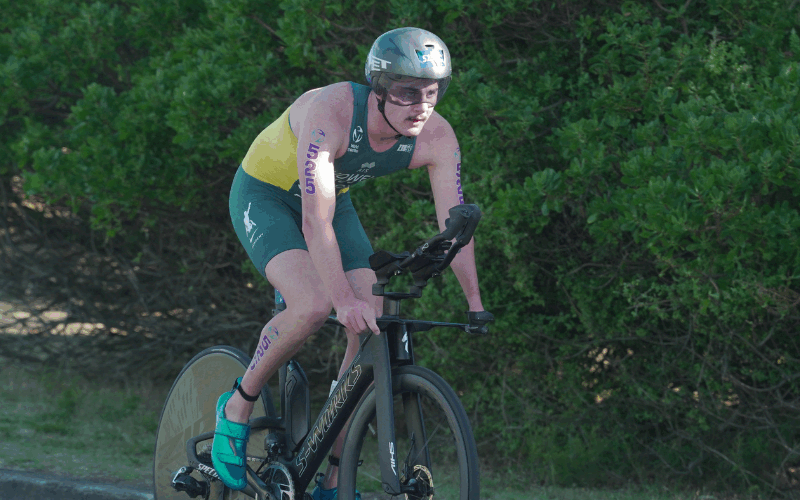
That side of him was on full display in Wollongong. Historically, Howell’s races followed a familiar pattern: dominate the swim, survive the bike, unleash the run. The bike leg had long been his weakness – the discipline he openly admits he disliked working on most. For two years, he hammered away at it anyway. Long rides. Brutal sessions. Endless repetition. And often, very little visible payoff, until suddenly, there was.
At Wollongong, Howell didn’t get swallowed on the bike, he stayed at the front for almost the entire race. For the first time, all the invisible work surfaced publicly. “That was the moment I realised where all the hard work goes,” he says. He ultimately finished second after getting caught late in the run, but the result almost felt secondary to the statement itself. Howell had shown the world what his ceiling might look like, and perhaps more importantly, he had shown himself. The performance carried extra emotional weight because it came directly after the disappointment of Paris. Heading into the Paralympics, Howell admits he underestimated just how different Paralympic racing would feel compared to normal world championship events.
“I robbed myself a little bit,” he says. That experience changed him, not emotionally. Strategically. In the aftermath of Paris, Howell and coach Brendan Sexton stripped everything back and reassessed. What actually worked for Howell, what kind of athlete was he really? The answer surprised them. Simplicity. Instead of chasing increasingly complicated sessions and hyper-specific training structures, they returned to basics – clear sessions, balanced planning and a more natural rhythm. The performances immediately improved. But Paris also taught Howell something much bigger.
The athletes who succeeded weren’t always the ones dominating headlines in the lead-up. Often, they disappeared quietly into training blocks, carefully building toward one specific moment. Now, Howell is approaching LA 2028 differently. “I want to win LA,” he says plainly. And for the first time in his career, he is building a true long-term plan around that ambition. “The people who performed in Paris were planning for it years out,” Howell says. “I don’t want to miss the boat.” That mentality has reshaped everything. Results may temporarily become less important. Certain races may matter less publicly while bigger physiological changes happen privately. And that maturity has been heavily influenced by Brendan Sexton.
When Howell moved to the Gold Coast roughly eight months before Paris, the shift forced him to confront what being a genuine high-performance athlete actually required. At the time, Howell admits he probably thought he already understood professionalism. Sexton, an Olympian himself, quickly identified not only Howell’s athletic weaknesses, but also the behavioural habits limiting his progression. Organisation. Planning. Recovery. Lifestyle management. “He gave it to me honestly,” Howell says. It was exactly what he needed. Now reunited with Sexton through the VIS system after returning home to Victoria, Howell feels more balanced than ever and ready to inspire the next generation of para-athletes emerging through the Australian system.
“They can lean on me,” he says. Not because he has all the answers, but because he still remembers exactly what those early moments felt like. The nerves. The excitement. The first Australian kit. Pulling on the green and gold remains one of the defining feelings of his life. “It never gets old,” he says. Neither does the pressure, if anything, he enjoys it more now. Because Howell knows being world number one guarantees absolutely nothing in modern Para triathlon. The margins are tiny. The fields are deeper than ever.
LA could realistically be decided by less than 90 seconds across the entire field, but Howell is determined to be ready for it.