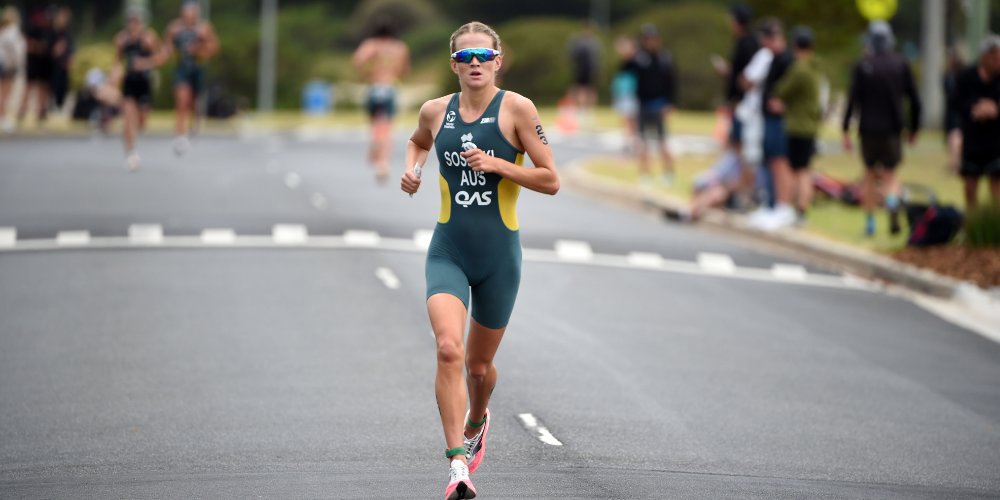
There is a quiet confidence about Tara Sosinski now that perhaps wasn’t there a few years ago.
Not arrogance. Not bravado.
Just belief.
After years spent battling injuries, rebuilding her running body and wondering when, or if, everything would finally click, the Australian triathlete can feel momentum building again.
The performances are improving. The consistency is returning. And for the first time in a long time, the 22-year-old feels ready to stop simply participating in races and start shaping them herself.
“I think especially this year, I want to be a player in the race,” Sosinski said.
“I want to lean on my strengths and really showcase that in a race format and make some moves.”
It is an important shift in mindset for one of Australia’s emerging triathlon talents as she enters the final year of her Under 23 eligibility, a season that could define the next phase of her career.
The goals are clear, be consistent on the World Cup circuit, build progressively and challenge for the Under 23 World Championship title later this year.
For Sosinski, it feels like the culmination of years of patience, the journey to this point has been anything but straightforward.
Like many Australian triathletes, Sosinski’s introduction to the sport happened organically.
Long before international racing and Olympic dreams, she was simply the youngest sibling trying to keep up with her older brothers.
“I have two older brothers and whatever they did, I wanted to be a part of it,” she said.
After the family moved to the Gold Coast, her brothers joined Surfers Paradise Triathlon Club and began training at Lake Evandale under respected coach Jenny Alcorn.
“I went home, told mum and dad that next week I’d be joining them and that was the start,” she said.
“I’ve never looked back.”
At just 11 years old, triathlon initially offered exactly what most kids want, fun, friendship and the chance to be active.
Sosinski still laughs remembering her first sessions.
“I was really scared,” she admitted.
“I was too scared to ride on the road by myself, so my dad had to ride with me.
“But I just loved it. I loved doing it with my friends. It was definitely more social than serious back then.”
Even her first race at Kingscliff remains vivid in her memory.
“It was raining and apparently I just cruised around with a massive smile on my face the whole time,” she said.
“I think I was out there for a very long time, but I definitely enjoyed myself.”
Over time, the sport gradually became more than just a social outlet.
As national-level racing opportunities emerged toward the end of high school, Sosinski began to realise she might actually have something special.
“I remember medalling at school nationals and thinking, ‘Okay, maybe I’m actually alright at this,’” she said.
That progression led her into high performance pathways and national development squads, but it also coincided with the most difficult period of her young career.
For almost three years, injuries became a constant companion.
Stress fractures repeatedly interrupted her progress at the exact moment many young triathletes begin making major leaps.
One injury sidelined her from running entirely for more than six months.
“It was definitely a rude shock,” Sosinski said.
“Up until then, I’d never really had an injury before.”
The timing, however, proved strangely beneficial in one respect.
Her first major injury occurred during Year 12, forcing her to temporarily shift focus away from sport and into academics.
“I was probably lucky in a way because I could really delve into my studies,” she said.
But physically and emotionally, the cycle of setbacks was draining.
“There was probably an 18-month period where I just never really felt like myself in races,” she said.
“There were little glimpses which almost made it harder because I knew it was in there somewhere.”
For endurance athletes, where confidence and rhythm are everything, repeated interruptions can become mentally exhausting. Sosinski admits there were times when simply getting back to running felt intimidating.
“The first time back running was pure excitement,” she said.
“But after a few more injuries, I definitely became cautious and scared it would happen again.”
The experience ultimately reshaped not only her approach to training, but her understanding of what it actually means to be an elite athlete.
“I learned so much through those injuries,” she said.
“Things like nutrition, training load, psychology, all the stuff outside of just swim, bike, run.
“I think it forced me to slow down and really understand the sport better.”
Now, as her body begins responding consistently again, Sosinski feels she is finally seeing glimpses of the athlete she always believed she could become.
“I feel like I haven’t reached my full potential yet because of those setbacks,” she said.
“So now seeing those little breakthroughs is really exciting.”
One of the biggest turning points in Sosinski’s resurgence came midway through 2024 when she made a significant change, asking her older brother Jack to become her coach.
The decision has transformed both her training and her confidence.
“Everyone always asks how often we fight,” she laughed.
“But honestly, hardly ever.”
Jack, who runs a coaching business, had gradually become more involved in Tara’s development through casual conversations and occasional input into her training.
Eventually, the transition felt natural.
“I wasn’t fully satisfied with what I was doing at the time,” Tara said.
“And obviously as siblings, you talk about that stuff.
“I could see what he was doing with his athletes and one day I just thought, ‘I’d really like him to coach me.’”
The partnership quickly clicked.
“I trust him completely,” she said.
“There’s no one I’d trust more.”
Importantly, the siblings have managed to separate the coach-athlete relationship from family life, something Tara believes has become one of their greatest strengths.
“We can go fully into triathlon mode and then completely switch it off and just be brother and sister again,” she said.
Under Jack’s guidance, Sosinski says training has become far more individualised to her strengths and physiology, a crucial factor after years of managing injury setbacks.
And the results are beginning to follow.
While triathlon occupies much of her life, Sosinski is adamant it does not define her.
Alongside training twice a day and travelling internationally to race, she is also studying a Bachelor of Biomedical Science at Griffith University, with ambitions of eventually pursuing epidemiology.
“I wouldn’t be the student I am without triathlon,” she said.
“And I wouldn’t be the athlete I am without my studies.”
That balance has become increasingly important as she navigates the pressures of elite sport.
Unlike many athletes who struggle when performances dip, Sosinski has built an identity beyond results.
“I’d like to think people see me as Tara, not just Tara the triathlete,” she said.
Even outside training and study, she admits she thrives on staying busy.
“I’m always doing something,” she laughed.
There is also another side to Sosinski many people wouldn’t expect.
Before triathlon took over completely, she spent 13 years doing ballet.
“I ditched the tutu for the trisuit,” she joked.
The discipline and self-awareness from ballet, however, still influence her approach today.
“When I loved ballet, I performed well,” she said.
“And when I fell out of love with it, I didn’t. That taught me how important happiness is in performance.”
It remains a philosophy she still carries into triathlon.
“If you love what you’re doing, it makes everything easier,” she said.
This season represents an important crossroads.
The Under 23 World Championships remain a major target, the last chance for Sosinski to race solely against athletes her own age before transitioning fully into elite competition.
“Under 23 Worlds is such a unique experience,” she said.
“It’s one of the only times where you’re racing your own age group only.”
At the same time, racing in elite fields has already begun accelerating her development.
“I think you learn so much just being around those athletes,” she said.
“Especially tactically. They’ve raced in so many different situations and environments.”
Watching athletes like Australia’s world champion Matt Hauser rise through the same pathways has only strengthened her belief that Australian athletes can compete with the very best.
“When you see someone come through the same system and then win a world title, it definitely shows what’s possible,” she said.
Long-term, the Olympic dream remains firmly in focus.
Los Angeles 2028 sits on the horizon.
But for Australian triathletes, Brisbane 2032 looms even larger.
“It’s always in the back of your mind,” Sosinski said.
“It’s not just a home Olympics, the course is basically an hour up the road from where we train.
“It feels real.”
For now though, the focus remains much smaller.
Consistency. Health. Continued progression.
After years of setbacks, Tara Sosinski is no longer simply hoping to belong.
She is preparing to contend.