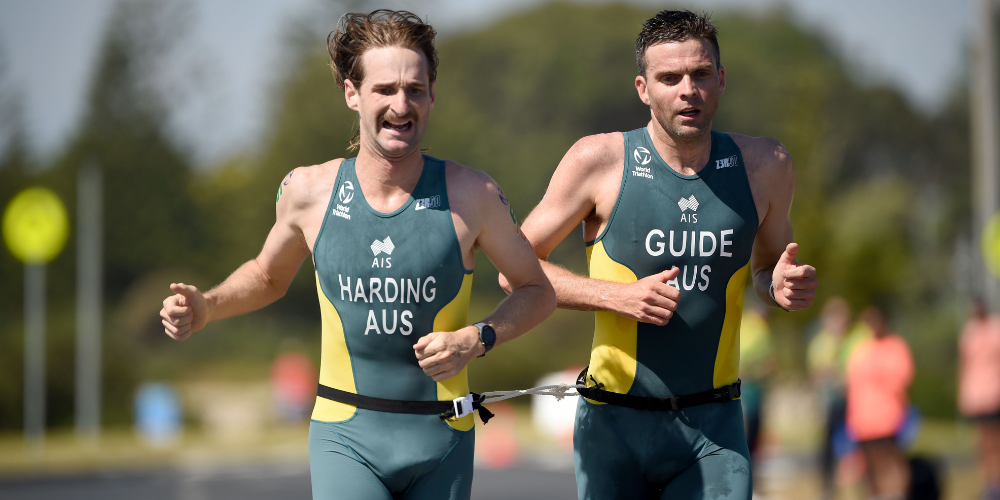
For years, Sam Harding built his identity around athletics.
Middle-distance running was the structure of his life, years of training in Canberra, Paralympic qualification, world-class coaches, and the relentless grind that comes with chasing fractions of seconds on a track. Triathlon was never really part of the plan.
Then the right conversation happened at the right time.
One of Harding’s long-time training partners, Avish Sharma, had worked with Triathlon Australia after completing a PhD in altitude studies. Around the time Harding qualified for the Tokyo Paralympics in the 1500 metres, Sharma floated an idea that would quietly alter the course of Harding’s sporting career.
“You can run pretty well,” Harding remembers being told. “You could learn to ride a bike and you know a really good swimming coach, so why not give triathlon a go after Tokyo?”
At the time, Harding was content in athletics. Comfortable, even. But comfort has never really been where elite athletes stay for long.
There was another lure too: the 2022 Commonwealth Games in Birmingham included a vision-impaired paratriathlon event. Suddenly, triathlon wasn’t just a curiosity — it was an opportunity.
After more than a decade in athletics, Harding figured a transition year might offer something fresh. If it worked, great. If not, there was still enough runway to return focus to the Paris Paralympics.
Instead, triathlon immediately started pulling him deeper.
“It just kind of went from strength to strength,” Harding says. “I met the right people at the right times.”
That sentence comes up repeatedly when talking to Harding. Right people. Right timing. But the deeper you go into his story, the clearer it becomes that none of it is accidental.
Because behind Harding sits one of the most extraordinary coaching networks in Australian para sport.
His athletics coach through Tokyo, Philo Saunders, was a senior physiologist at the AIS with experience spanning multiple elite sports. Before that came Ukrainian-born coach Iryna Dvoskina — one of the most decorated Paralympic athletics coaches in the world, with an astonishing medal tally attached to athletes she has mentored.
Then there was Yuri Dvoskina, the former Ukrainian Paralympic head swim coach, who Harding first encountered through cross-training sessions before eventually asking him to take over his swimming development.
By Harding’s own admission, he has spent his career surrounded by some of Australia’s most successful high-performance minds.
And still, he believes he is only scratching the surface.
“I wouldn’t say I’ve plateaued yet,” he says. “I’m looking forward to LA and seeing how things progress there.”
That ambition sharpened again after Paris.
Watching Australian guide and former elite triathlete Aaron Royle train in St. Moritz exposed what Harding calls “pretty big gaps” in how he was approaching triathlon preparation.
Enter Darren Smith — one of Australia’s most respected endurance coaches — who helped accelerate Harding’s development.
The result is an athlete who believes his ceiling is still moving.
But the real heartbeat of Harding’s triathlon story isn’t only about coaching systems or performance gains.
It’s about trust.
Because in paratriathlon, particularly in the vision-impaired category, success depends on something rare in elite sport: complete surrender to another person.
For Harding, that person is Royle.
Their partnership almost didn’t happen.
Back at the 2022 Commonwealth Games, Harding had heard whispers that Royle might be interested in guiding. Nothing materialised. A year later, he heard the same thing again.
This time, he skipped the formal channels and messaged Royle directly on Instagram.
At that stage, Harding’s previous guide Luke had been injured, while another guide, Dave Mainwaring, had helped him secure qualification for Paris. Harding was acutely aware of the emotional politics involved.
Royle felt the same.
“My first reaction was, ‘I don’t want to step on David’s toes,’” Royle says.
Mainwaring, however, made the decision easy.
“If Aaron’s keen, he should do it,” he told Harding.
That selflessness, Harding says, defines the guide community.
“These guys are helping me get through the race,” he says. “Without Dave, I wouldn’t have qualified for Paris.”
The timing was hardly ideal.
Royle was still living in the UK. They had roughly six months before the Paralympics. Their first race together came only about two months before Paris.
Everything was accelerated.
“We were on a very steep and fast learning curve,” Royle says.
Yet somehow, it clicked.
Not perfectly. Not immediately. But enough to realise what might eventually be possible.
The mechanics of guiding are far more complex than most spectators realise.
Communication is constant — but also carefully rationed.
Every word costs energy.
“You’re trying to do that during a race when you’re going full gas,” Royle explains. “Even talking right now, I’m trying to catch my breath.”
So the pair learned efficiency.
What absolutely needed to be communicated? What could be instinctive? What could be felt rather than spoken?
On the bike, they refined systems. In transitions, they identified weaknesses. In the swim, they discovered that being too physically close actually slowed them down.
Now they race at the very edge of the tether’s allowable distance, giving Royle room to swim freely while Harding finds rhythm independently.
At buoy turns, Royle gives Harding a quick tap on the head to signal direction changes.
“Well… usually a polite one,” Royle laughs.
Some are less polite than others.
The entire partnership is built on repetition, familiarity and sensory memory. Harding talks about learning courses through sound, feel and orientation. The more times he experiences a venue, the more natural it becomes.
Transitions remain the hardest.
New courses can feel disorientating and chaotic — moments where fractions of hesitation matter.
But Harding’s ability to adapt has already been tested far beyond race courses.
Like the time he attempted to transport an empty tandem bike box through Los Angeles en route to a training camp in Flagstaff.
When airline staff refused to let the oversized box board the connecting flight to Phoenix, Harding — travelling solo — was forced into a bizarre logistical scramble involving Delta Cargo, a hidden box behind a bush, a GPS pin-drop and a courier sent to recover it.
Most athletes would have imploded.
Harding shrugs at the memory.
“What can you do?”
That attitude — calm, practical, quietly resilient — seems to underpin almost everything about him.
It also explains why those around him invest so heavily in his success.
Harding repeatedly returns to the people behind the scenes: family, coaches, guides, administrators.
His parents helped sustain his athletics career through years without support funding. Triathlon Australia, he says, helped make the transition possible. High-performance managers moved mountains to get opportunities aligned.
And then there are the guides.
“In athletics, it’s just you on the line,” Harding says. “In triathlon, someone really wants to help you get around the course as quickly as possible. That’s really special.”
Royle jokes Harding is underselling himself when he calls himself “the handbrake” in the partnership.
But the dynamic between them is obvious.
There’s humour. Familiarity. A level of trust that can’t really be manufactured.
By the time LA 2028 arrives, Royle will be nearing 40. He describes it as one final major goal at the back end of his elite sporting life.
For Harding, the focus is simpler: keep progressing.
The swim is improving. The bike has taken a leap forward. Consistency is building.
And now, for the first time, his guide is also helping shape his coaching structure.
“Aaron knows exactly where I am,” Harding says. “He knows exactly how it feels in the races.”
That intimacy — tactical, physical and emotional — may ultimately become their greatest advantage.
Because for all the science, systems and preparation surrounding elite paratriathlon, the core of the sport still comes back to something deeply human:
Two athletes learning how to move as one.